
Walk into an electronics store and head toward the wearable tech section. Before you compare battery life, screen size, or price, something has already shaped your first impression: the display.
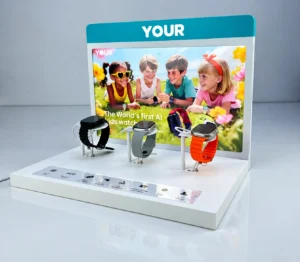
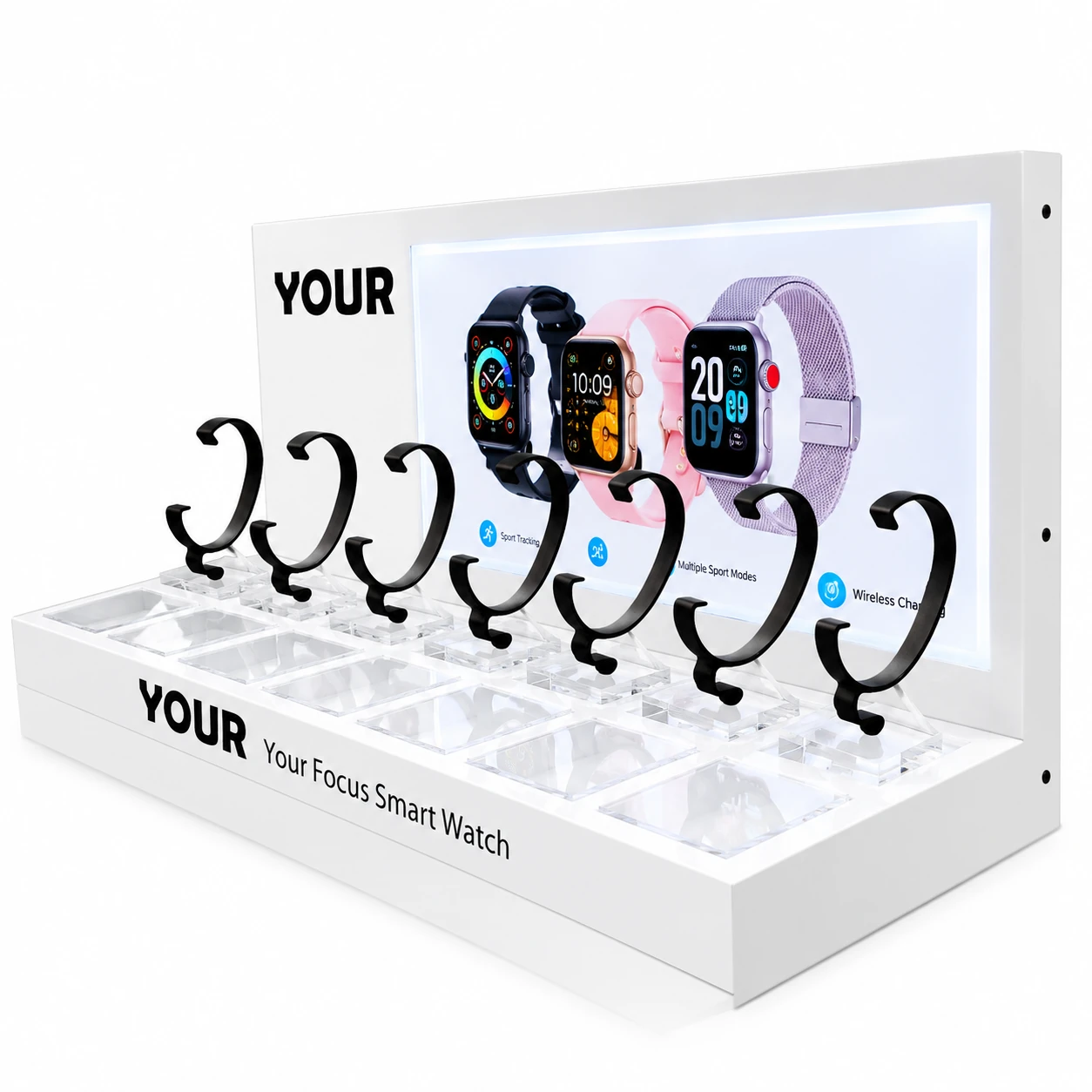
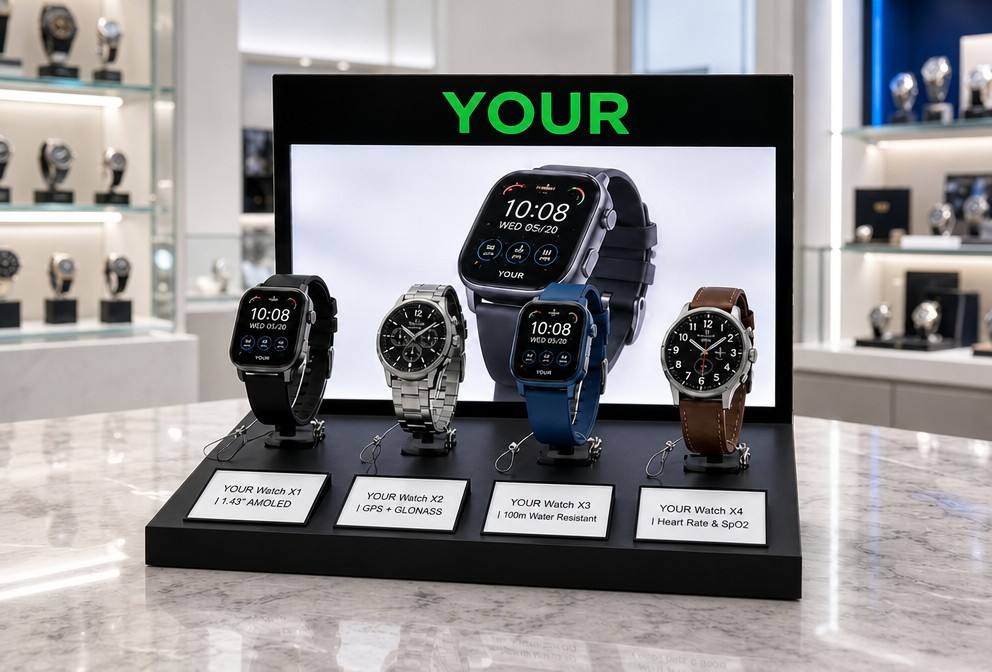
One smart watch may sit upright on a clear stand. Another may be presented at a slight angle, with the screen facing you. Several models might be arranged neatly side by side beneath a brand logo.
That small structure holding the product is a smart watch display stand.
It may look simple, but it has an important job.
A well-designed smart watch display stand does more than keep a watch off the counter. It helps organize products, improves visibility, supports brand presentation, and makes it easier for shoppers to compare different models.
For retailers, watch brands, electronics stores, and distributors, those small details matter.
So, what exactly is a smart watch display stand? Where is it used? And why are acrylic smart watch displays so common in retail environments?
Let’s take a closer look.
What Is a Smart Watch Display Stand?
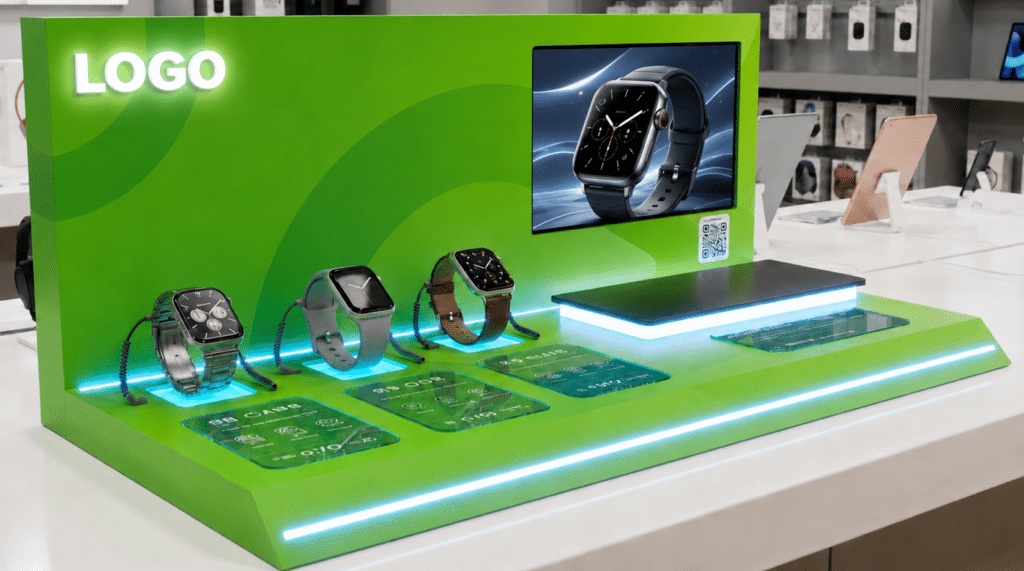
A smart watch display stand is a fixture designed to hold and present one or more smart watches in a retail store, showroom, trade show, exhibition, pop-up shop, or other commercial environment.
Think of it as a small stage.
The watch is the star. The display stand simply helps put it in the right position.
Depending on the design, a smart watch display can hold a single watch or several models at once. It may sit on a retail counter, inside a glass showcase, on a shelf, or as part of a larger branded display fixture.
Common materials used for smart watch display stands include:
- Acrylic
- Metal
- Wood
- ABS and other plastics
- Mixed materials
Among these materials, acrylic is especially popular for modern retail displays.
Clear acrylic has a clean appearance and allows the product to remain the visual focus. Colored acrylic, meanwhile, can be used to match a brand’s visual style or create contrast around the watch.
The structure itself can be very simple—a base and a watch holder—or more complex, with several levels, printed graphics, logos, cable holes, interchangeable components, or security features.
There’s no single design that works for every project.
The right display depends on the watch, the store environment, the available space, and how customers will interact with the product.
Is a Smart Watch Display Stand Just a Watch Holder?
Not quite.
A personal watch holder and a retail smart watch display stand may look similar, but they’re built for different purposes.
A watch holder beside your bed mainly needs to keep your watch in one place.
A retail smart watch display stand may need to present the same product to hundreds of shoppers while staying stable, organized, clean, and consistent with the surrounding store design.
It may also need to:
- Display several watch models clearly
- Hold each watch at a comfortable viewing angle
- Show a logo or marketing message
- Fit within a limited countertop area
- Leave important product details visible
- Allow space for charging cables
- Support security cables or anti-theft systems
- Handle repeated customer interaction
- Match other retail fixtures
There’s a simple rule behind many successful displays: the stand should support the product, not compete with it.
That’s one reason clear acrylic works so well.
When the structure is kept clean and the acrylic edges are properly finished, the stand can almost disappear visually. Your eye goes to the smart watch first.
And that’s exactly what a product display is supposed to do.
Why Does a Smart Watch Display Matter in Retail?
Picture two identical smart watches.
One is lying flat on a counter next to a price card and a few charging cables.
The other is positioned upright on a neat display stand, with enough space around it to clearly see the screen, case, strap, and finish.
Same watch.
Very different presentation.
Retail display design affects how easily shoppers can notice, understand, and compare products.
This becomes particularly important with smart watches because many models have similar shapes. Place several of them flat on one surface and things can get messy quickly.
A well-planned smart watch retail display creates visual order.
It can separate different models, colors, or sizes while keeping them connected as part of the same collection.
Spacing matters too.
Put a tiny watch on an oversized fixture and the display may overwhelm the product. Put eight watches on a base that’s too small and you’ve created something that looks more like rush-hour traffic than a premium retail display.
The goal is balance.
Enough structure to organize the products. Enough empty space to let them breathe.
Where Are Smart Watch Display Stands Used?
Smart watch display stands are used in many commercial settings, from large electronics retailers to temporary exhibition booths.
The basic purpose remains similar, but the design requirements can change considerably from one environment to another.
Electronics Stores
Electronics stores are probably the most familiar setting for a smart watch display stand.
Retailers may use individual stands for premium models or larger multi-unit displays for an entire product series.
A display can organize products by:
- Model
- Screen size
- Color
- Strap type
- Feature
- Price range
For multi-watch displays, spacing is especially important.
Each watch should feel like an individual product while still appearing connected to the collection around it.
Clear acrylic works well in this setting because it adds relatively little visual weight to the counter.
Smart Watch Brand Stores and Showrooms
Brand-owned stores usually require more than a generic watch holder.
The display may need to match the brand’s existing retail identity, including its colors, graphics, materials, and overall visual style.
That’s where a custom smart watch display stand becomes useful.
Instead of making the watch fit a standard display, the display can be designed around the product.
For example, a custom stand may be developed according to:
- Watch dimensions
- Case shape
- Strap size
- Number of models
- Brand colors
- Logo requirements
- Retail counter dimensions
- Product launch themes
This creates a more consistent presentation across the retail environment.
Mobile Phone and Accessories Stores
Smart watches are often sold alongside smartphones, earbuds, chargers, phone cases, straps, and other accessories.
And let’s be honest—counter space disappears quickly.
In these stores, a compact countertop smart watch display can be more useful than a large decorative fixture.
Designs may use raised platforms, vertical arrangements, or stepped levels to display several watches without taking over the entire counter.
This is a good example of why bigger isn’t always better.
Sometimes the smartest display is simply the one that uses space well.
Jewelry and Watch Stores
Smart watches aren’t always presented as electronic gadgets.
Premium models may be displayed alongside traditional watches, fashion accessories, or jewelry.
In this environment, the display often needs a quieter and more refined appearance.
A clear acrylic watch stand can work well because it doesn’t introduce too much visual noise. Black, white, frosted, or other acrylic finishes can also be used when the store requires a stronger visual identity.
The presentation goal changes slightly here.
Instead of saying, “Look at this piece of technology,” the display may need to communicate, “This is something you’ll want to wear.”
It’s a subtle difference, but it can influence the entire display design.
Department Stores
Department stores may use smart watch displays in electronics departments, accessory areas, branded shop-in-shop spaces, or temporary promotional zones.
Because these displays often need to fit existing counters or cabinets, dimensions become critical.
A beautiful display that’s 20 mm too wide is still 20 mm too wide.
That’s why accurate measurements matter before production begins.
Buyers should consider the available width, depth, and height, as well as nearby fixtures, customer viewing angles, cable positions, and product spacing.
These details aren’t glamorous.
They are, however, the details that determine whether a display actually works once it arrives in the store.
Trade Shows and Exhibitions
Trade shows create a different challenge.
Visitors may walk past dozens—or hundreds—of booths in a single day. A product often has only a few seconds to catch someone’s attention.
A smart watch exhibition display therefore needs to communicate quickly.
Acrylic display stands can be combined with:
- Printed brand logos
- Product names
- Feature cards
- QR codes
- Raised platforms
- Multi-level structures
- Removable graphic panels
Portability may matter too.
Trade show displays often need to be packed, shipped, unpacked, installed, and packed again.
A gorgeous display that requires half the booth team to assemble it probably won’t become anyone’s favorite travel companion.
Pop-Up Stores and Product Launches
Launching a new smart watch?
A custom display can help give the product its own visual identity.
Pop-up stores and launch campaigns often use displays built around a specific model, feature, color, or campaign theme.
Because these campaigns may run for a limited period, brands often need to balance appearance with practical concerns such as production quantity, shipping, assembly, durability, and budget.
This is also where prototypes can be valuable.
A physical sample can reveal things that aren’t always obvious in a drawing or 3D rendering.
Maybe the viewing angle feels slightly wrong.
Maybe two watches are positioned too close together.
Maybe the base needs more support.
Small issues on a computer screen can become very noticeable when the actual product is sitting on the counter.
What Are the Common Types of Smart Watch Display Stands?
There’s no universal smart watch display format, but several styles are commonly used.
Single Smart Watch Display Stand
A single-watch stand holds one product.
These displays work well for hero products, premium models, new releases, or situations where each watch needs its own space.
The design may look simple, but several details still matter:
- Display height
- Viewing angle
- Base dimensions
- Holder shape
- Watch size
- Strap position
- Stability
Sometimes simple products demand surprisingly careful design.
Multi-Watch Display Stand
A multi-watch display presents several watches on one fixture.
This format works well when retailers want to show different colors, models, sizes, or an entire watch collection together.
Common layouts include:
- Straight rows
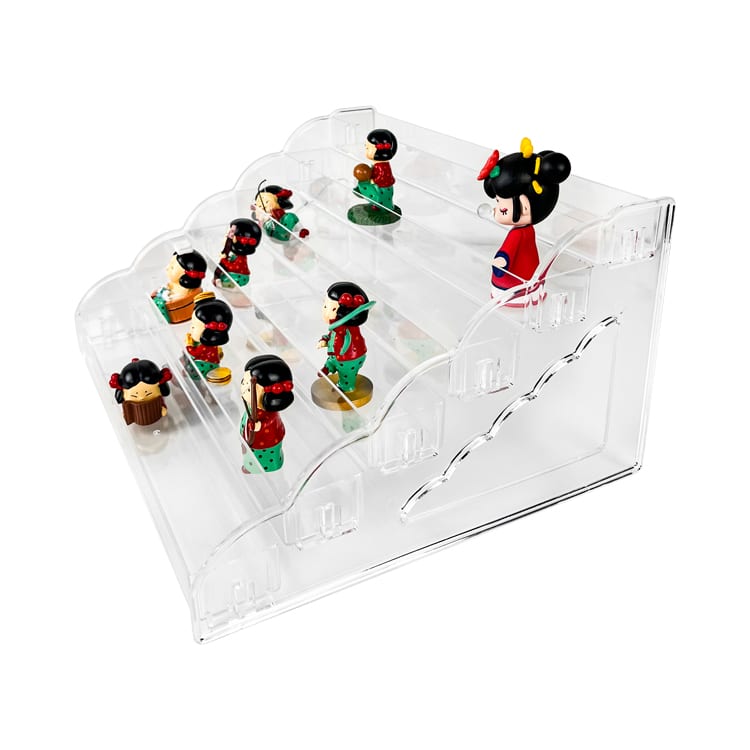
- Stepped levels
- Tiered platforms
- Individual raised holders
- Circular arrangements
The correct layout depends on how customers will approach and view the products.
For example, a display positioned against a wall may need a different arrangement from one placed in the center of a retail table.
Countertop Smart Watch Display
A countertop smart watch display stand is designed for a sales counter, retail table, shelf, or display cabinet.
Since counter space is often limited, these displays usually need a compact footprint.
Stability is important as well, especially when customers are allowed to touch and try the watches.
The base needs to remain stable without becoming unnecessarily large.
Sounds simple. It isn’t always.
That’s where thoughtful product dimensions and prototyping can make a noticeable difference.
Branded Smart Watch Display
A branded display incorporates elements such as a company logo, product name, campaign message, or brand color.
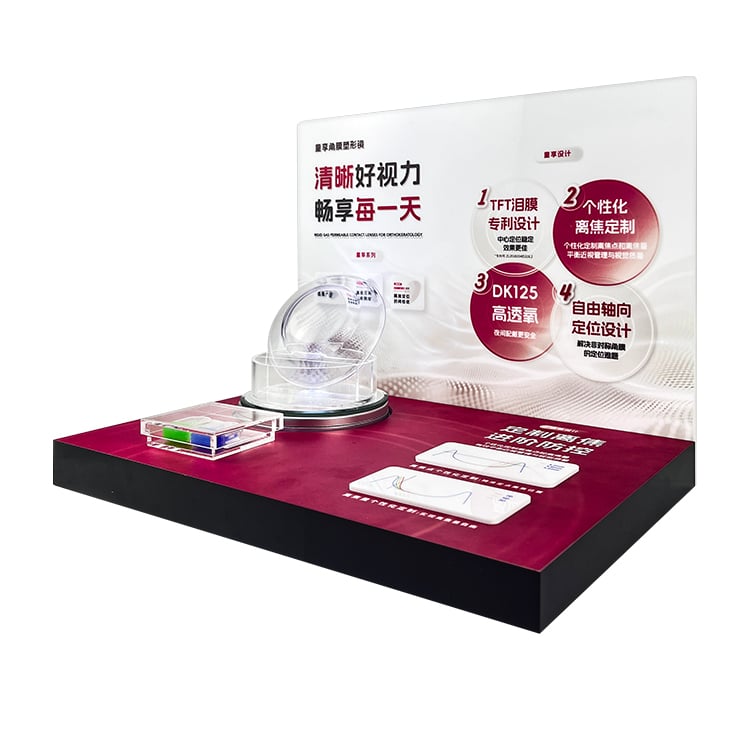
With acrylic displays, branding can be created in several ways depending on the design.
These may include:
- UV printing
- Screen printing
- Engraving
- Applied graphics
- Separate acrylic logo pieces
- Printed graphic panels
The logo shouldn’t compete with the watch.
A small logo in the right place can look polished and deliberate. A huge logo fighting for attention with the product? Well, the watch probably won’t thank you.
Why Is Acrylic Used for Smart Watch Display Stands?
Acrylic offers a useful combination of appearance, fabrication flexibility, and material options.
That’s why you’ll see it frequently in retail displays for watches, cosmetics, electronics, eyewear, jewelry, and other relatively small products.
Clear Acrylic Keeps Attention on the Watch
Transparent acrylic offers high light transmission and creates a clean visual effect.
Rather than placing a heavy-looking structure around the watch, clear acrylic can provide support while allowing the product to remain the focal point.
This is particularly useful for modern electronics stores and minimalist retail environments.
Acrylic Can Be Fabricated Into Different Shapes
Acrylic can be cut, bent, bonded, polished, engraved, and printed.
That gives designers considerable freedom when developing a custom acrylic smart watch display.
Depending on the design, manufacturers can create:
- Flat bases
- Angled holders
- Raised platforms
- Tiered displays
- Logo panels
- Sign holders
- Multi-product structures
Acrylic is also available in different thicknesses and colors.
Clear isn’t the only choice.
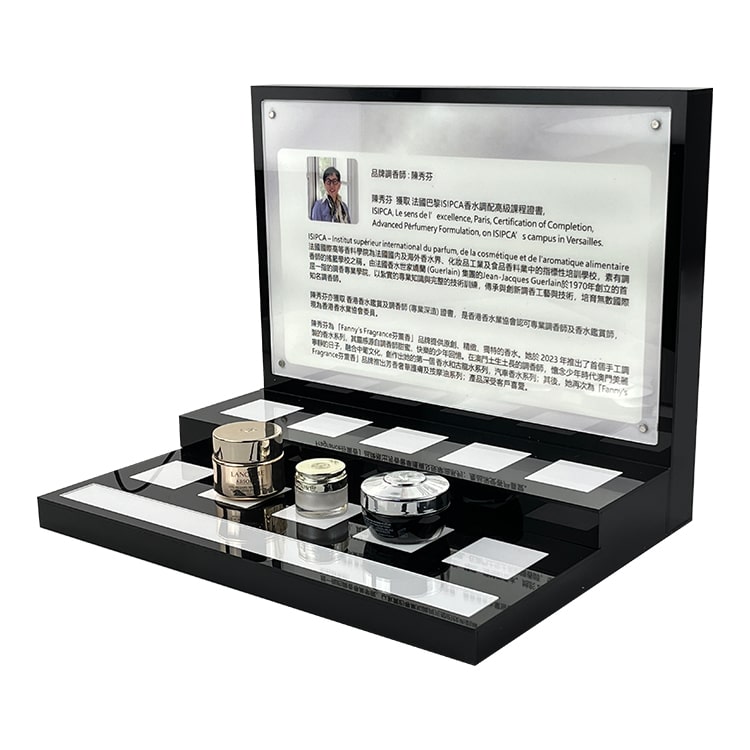
Black, white, frosted, translucent, and colored acrylic can all create very different visual effects.
Acrylic Works Well With Branding
Brand identity matters in retail.
Acrylic provides a relatively clean surface for printed logos, graphics, text, or decorative elements.
For a product launch, for example, a clear base might be combined with a printed logo panel. A black acrylic platform might be used for a darker premium look.
The design should follow the product and retail environment—not simply use acrylic because acrylic happens to be available.
That’s worth emphasizing.
Acrylic isn’t automatically the right material for every smart watch display.
Metal may be more suitable when greater structural strength is required. Wood may suit warmer retail environments. Mixed-material designs can combine different visual and structural properties.
The material should serve the display.
Not the other way around.
Can Smart Watch Display Stands Be Customized?
Yes, and for many B2B retail projects, customization is the main reason to manufacture a display rather than buy a generic holder.
A custom smart watch display stand can be designed around the actual product, available retail space, and brand requirements.
Customization may include:
- Overall dimensions
- Number of watches
- Acrylic thickness
- Acrylic color
- Product viewing angle
- Base shape
- Logo position
- Printed graphics
- Engraving
- Cable holes
- Charging cable management
- Security cable access
- Replaceable graphic panels
- Packaging requirements
There’s another part buyers sometimes overlook: what happens after the display leaves the factory?
How will it be packed?
Will store employees need to assemble it?
Could the graphics need replacement for a future promotion?
Will different markets require different languages?
These questions may not be exciting, but they matter.
Retail displays live in real stores, not in perfect 3D renderings.
How Do You Choose the Right Smart Watch Display Stand?
Start with the watch—but don’t stop there.
The best display concept considers the product, retail space, customer interaction, branding, and production requirements together.
Here are a few questions worth asking before developing a custom display.
How Many Watches Will Be Displayed?
One watch and ten watches require very different structures.
If you’re displaying several models, consider how customers will compare them and how much space should separate each product.
Where Will the Display Be Used?
A glass cabinet, electronics counter, jewelry store, exhibition booth, and pop-up shop all create different requirements.
Knowing the final location helps determine dimensions, materials, structure, and presentation style.
Will Customers Touch the Watches?
If customers can pick up or try the watches, stability becomes more important.
You may also need to consider charging cables, security cables, and how easily the watch can return to its original position.
Does the Display Need a Logo?
If branding is required, logo artwork should be prepared early in the project.
Logo dimensions, colors, printing methods, and placement can then be considered as part of the structure rather than added as an afterthought.
Do the Watches Need Charging?
If watches need to remain powered while displayed, cable management should be considered during the design stage.
A small cable hole in the right place can make a display look much cleaner.
How Much Counter Space Is Available?
Measure the actual space.
Seriously.
Don’t rely on a rough guess if you can avoid it.
Knowing the maximum width, depth, and height can prevent a frustrating situation later when a finished display doesn’t fit the intended counter.
What Information Is Needed for a Custom Smart Watch Display?
If you’re requesting a custom smart watch display from a manufacturer, providing clear information early can make the development process much smoother.
Useful information may include:
- Smart watch dimensions
- Product photos
- Number of watches per display
- Required display dimensions
- Preferred material
- Preferred acrylic color
- Logo artwork
- Branding requirements
- Expected order quantity
- Reference images
- Drawings or sketches
- Intended retail environment
- Packaging requirements
Don’t worry if you don’t have a finished technical drawing.
A reference image or even a simple sketch can often help explain the basic idea.
The important part is communicating what the display needs to accomplish.
From an Idea to a Finished Acrylic Smart Watch Display
A custom acrylic smart watch display usually begins with requirements, not machinery.
First, the basic questions need answers.
What is being displayed? How many watches? Where will the stand be used? How large can it be? Does it need branding?
Once the structure and dimensions are confirmed, the acrylic components can be fabricated according to the design.
Depending on the project, production may involve processes such as:
- Acrylic cutting
- Edge finishing and polishing
- Heat bending
- Bonding
- Printing
- Engraving
- Assembly
- Inspection
- Packaging
For custom projects, a prototype or sample may be useful before a larger production run.
This allows the physical fit, proportions, viewing angle, stability, and overall appearance to be checked with an actual product.
Manufacturing experience matters here.
A display may look excellent on a computer screen yet behave differently as a physical object.
Perhaps the base needs a little more support. Maybe the holder should move a few millimeters. Perhaps the watch looks better at a slightly different angle.
They’re small changes.
But small changes can be the difference between a display that merely looks good in a rendering and one that works properly in a real store.
A Small Display With a Surprisingly Big Job
A smart watch display stand isn’t the largest or most complicated fixture in a retail store.
That’s exactly why it’s easy to underestimate.
Its first job is simple: hold the watch.
But a good display does more.
It organizes the product, controls the viewing angle, reduces visual clutter, supports branding, and helps create a cleaner shopping experience.
In an electronics store, it can help customers compare several models.
In a jewelry store, it can give a smart watch a more refined presentation.
At a trade show, it can help organize products on a busy exhibition table.
And in a branded retail environment, a custom acrylic smart watch display stand can become a small but important part of the overall visual identity.
The display doesn’t need to steal the spotlight.
It simply needs to put the watch where the spotlight belongs.
Frequently Asked Questions About Smart Watch Display Stands
What is a smart watch display stand used for?
A smart watch display stand is used to hold, organize, and present smart watches in retail stores, showrooms, exhibitions, pop-up shops, and other commercial spaces. It can improve product visibility and help customers compare different watch models more easily.
What material is suitable for a smart watch retail display stand?
Acrylic, metal, wood, plastics, and mixed materials can all be used. Acrylic is commonly used for modern smart watch retail displays because it can provide a clean appearance and can be cut, bent, polished, printed, and fabricated into many shapes.
Can an acrylic smart watch display stand be customized with a logo?
Yes. A custom acrylic smart watch display stand can include logos, printed graphics, engraving, brand colors, and other visual elements. The suitable branding method depends on the display design, acrylic type, artwork, quantity, and required finish.
Can a custom smart watch display stand hold multiple watches?
Yes. A multi-watch display stand can be designed to hold several models, colors, or sizes on one fixture. Product spacing, viewing angles, holder positions, base dimensions, and cable requirements should be considered during the design process.
What information should I provide when requesting a custom smart watch display stand?
It helps to provide the smart watch dimensions, product photos, number of watches to display, preferred display size, material and color requirements, logo artwork, expected quantity, reference images or sketches, and details about where the display will be used.