Brief description
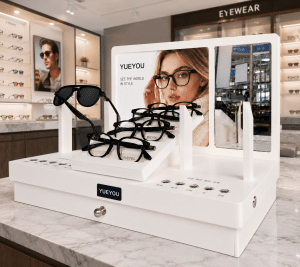
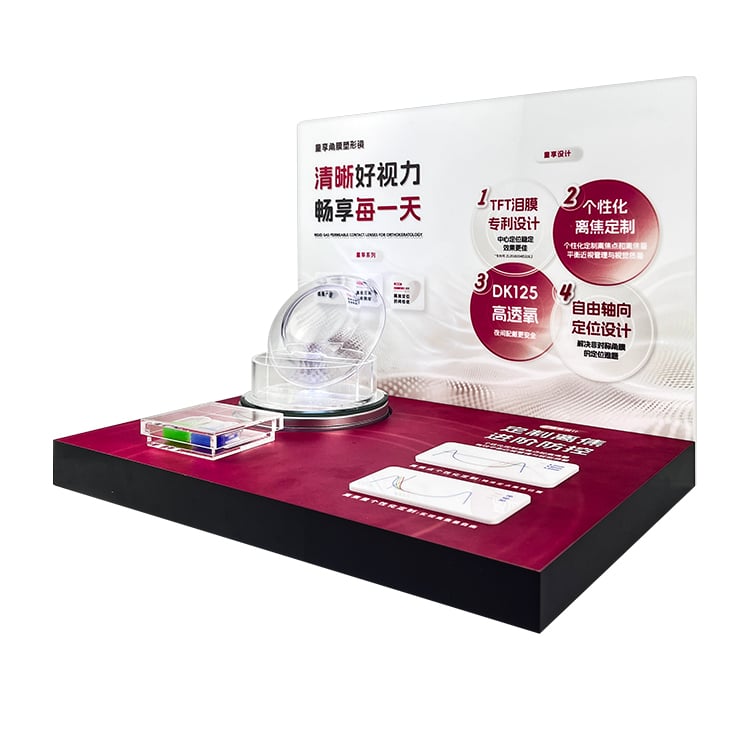
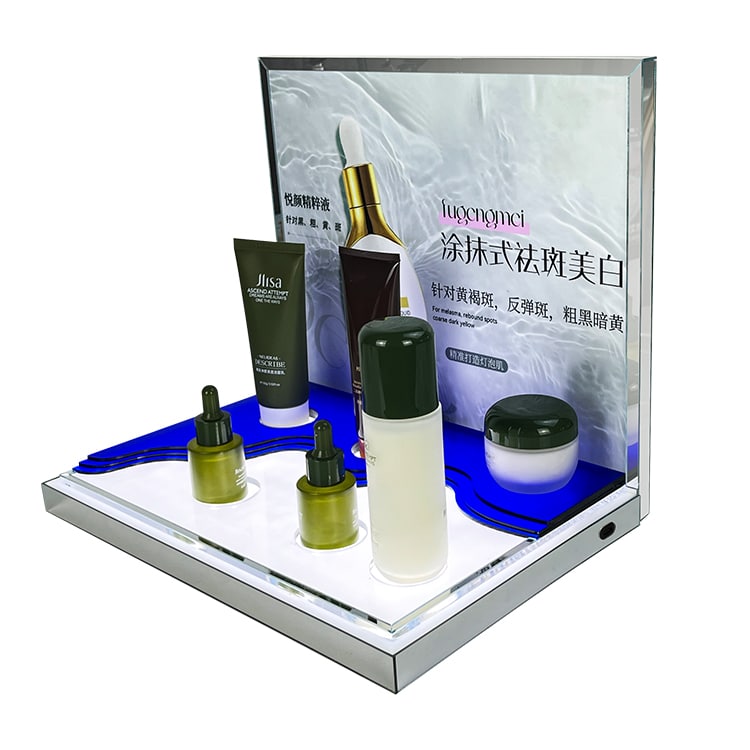
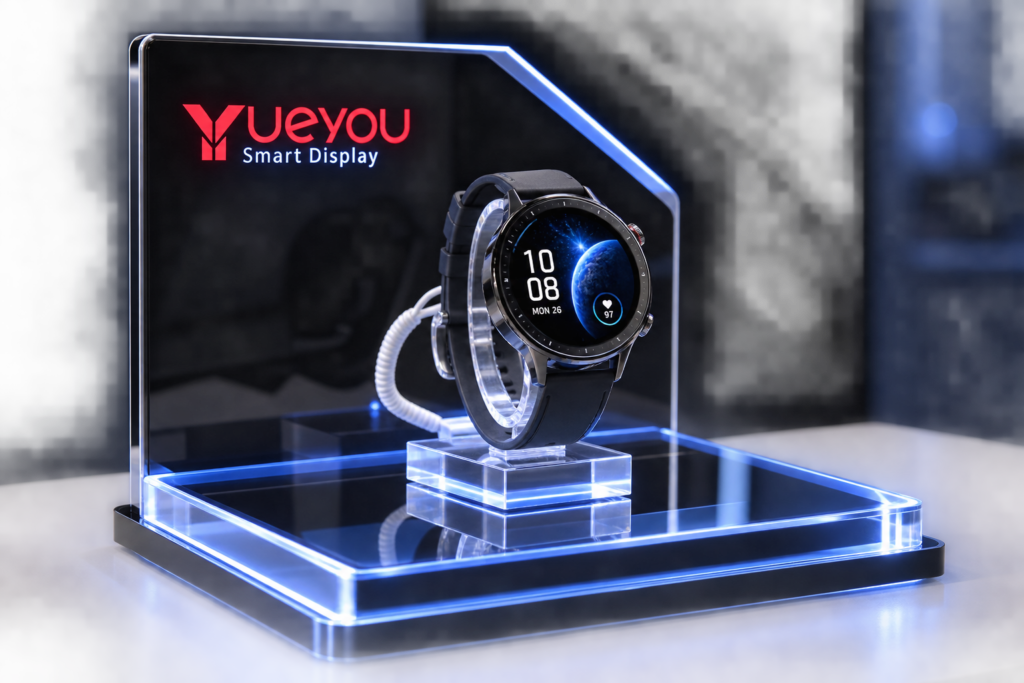
An LED acrylic smartwatch display stand for a brand launch event should do more than hold the product. It needs to attract attention, present the watch at the correct viewing angle, support live demonstration and express the visual identity of the brand.
For smartwatch brands, the display used at a product launch is usually more demanding than a standard retail holder. It may need to support press photography, media interviews, product demonstrations, VIP previews and customer interaction during the same event.
The most effective solution is normally a customized display system that combines acrylic fabrication, LED lighting, charging integration, logo branding and stable product support. The design should be developed around the actual smartwatch, the event environment and the way visitors will interact with the product.
A customized acrylic smartwatch display stand can provide a clean product presentation while allowing the brand to control lighting, product position and visual consistency across different event areas.
Why a Brand Launch Display Is Different
A retail display is often designed for long-term use, stock replenishment and basic product security. A launch-event display has a shorter operating cycle but a much higher visual requirement.
The display may be seen from across the venue, photographed by the media, recorded by influencers and inspected at close range by potential customers. In some cases, visitors may also pick up the watch, try on the strap or interact with the product specialist.
This creates three separate requirements. The stand must look attractive from a distance, remain refined in close-up photography and continue to function after repeated handling.
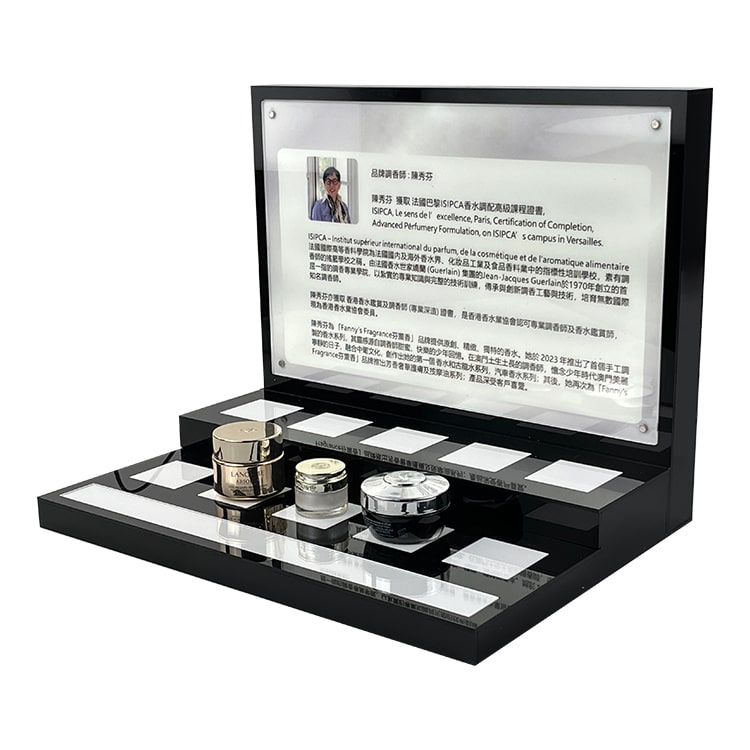
The acrylic should support the product without becoming the main visual subject. Clear acrylic is often used for a lightweight and transparent appearance, while frosted, black or colored acrylic can be added when the brand needs stronger contrast or a more distinctive campaign style.
Choosing the Right Display Format
The display format should be selected according to the purpose of the launch area. A hero display near the keynote stage may require a larger structure and stronger visual impact, while a media table may need a smaller display that allows easy access to the product.
| Display format | Main purpose | Recommended design direction | Key consideration |
|---|---|---|---|
| Single-watch hero stand | Present the flagship model | Large acrylic base, controlled LED lighting and strong brand visibility | Must look impressive without hiding the watch |
| Interactive demo stand | Allow visitors to handle the product | Stable base, charging integration and controlled security cable | Movement should feel natural and unrestricted |
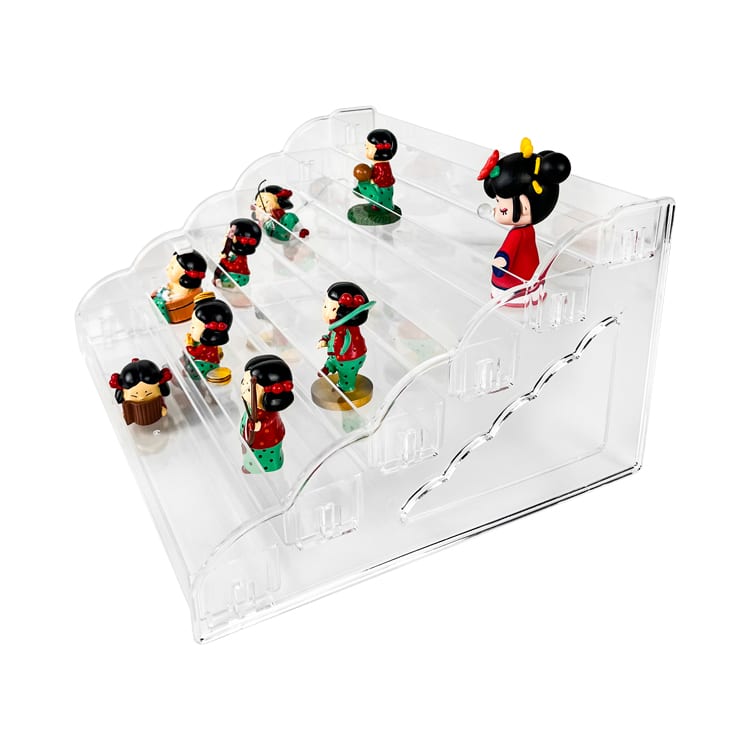
| Multi-watch display rack | Show a product family or color range | Layered or modular acrylic structure | Spacing and alignment must remain consistent |
| Media and photography display | Support product photography and video | Clean background, soft light and minimal visual interference | Reflections and glare must be controlled |
| Retail partner launch display | Extend the campaign into stores | Compact, repeatable and easy to assemble | Must be suitable for batch production |
For a brand preparing a complete wearable-product launch, the smartwatch display can also be coordinated with a wider 3C display solution for earbuds, headphones or other connected devices.
Designing the Acrylic Structure Around the Product
The factory should not begin with a fixed acrylic holder and then try to fit the smartwatch into it. The structure should be developed from the product dimensions and the intended customer interaction.
The watch case size, strap width, charging position and product weight all affect the holder design. The angle of the watch also needs to be considered. A steep angle may create a strong hero presentation, but it can produce screen reflections or make the product difficult to handle.
The base must also match the display height and the expected level of interaction. A small static stand may work for photography, but an interactive display usually needs a wider or heavier base to prevent movement when visitors pick up the watch.
Acrylic thickness should not be selected only by appearance. It depends on the overall size, support span, structure, product weight and transportation conditions. Technical acrylic suppliers publish different data for light transmission, surface finish and mechanical performance, so the final choice should be confirmed through a physical sample rather than a general thickness rule. Acrylic technical information from Röhm
| Acrylic element | Possible material or finish | Design purpose | Factory inspection focus |
|---|---|---|---|
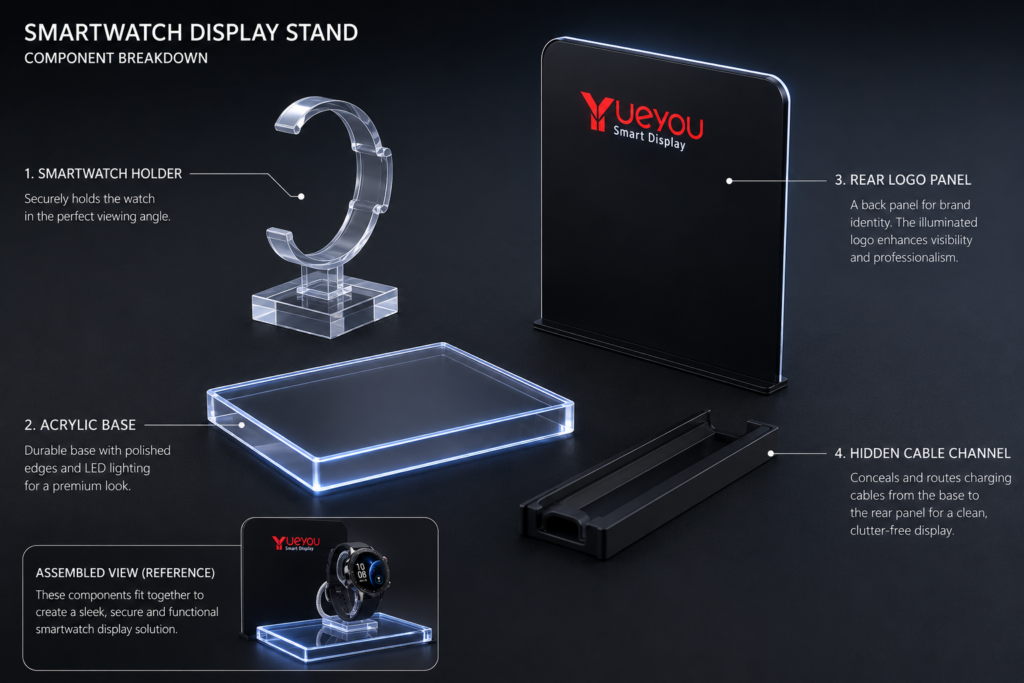
| Product holder | Clear or frosted acrylic | Supports the watch while keeping it visible | Product fit, edge quality and viewing angle |
| Main base | Clear, black or colored acrylic | Provides stability and brand presence | Flatness, weight distribution and surface finish |
| Rear logo panel | Frosted, clear or translucent acrylic | Carries the brand message or illuminated logo | Light diffusion and logo alignment |
| Side or edge panel | Transparent or colored acrylic | Creates depth and lighting effects | Color consistency and connection strength |
| Cable cover | Opaque or translucent acrylic | Conceals charging and security wiring | Easy access for maintenance and clean appearance |
LED Lighting Should Support the Product
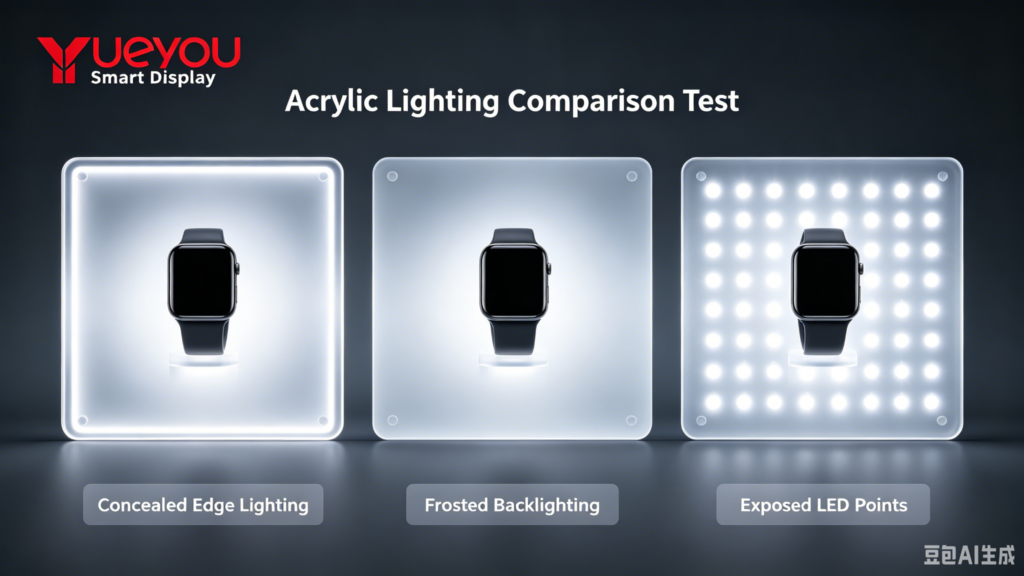
LED lighting is often the visual focus of a launch display, but the purpose of the lighting is to guide attention toward the smartwatch.
Directly exposed LED points can create an uneven appearance. They may also produce bright reflections on the watch screen, especially when the display is filmed or photographed at close range.
Acrylic can be used as an edge-lit component, a frosted diffuser or a backlit brand panel. Technical acrylic manufacturers such as Röhm demonstrate how transparent and colored acrylic can be integrated with lighting to produce controlled visual effects. Röhm illuminated acrylic applications
The final lighting method depends on the watch finish and the event environment. A silver metal case, black case and colored case will reflect light differently. The background and LED color should therefore be checked together with the product finish.
The most important lighting factors are not limited to brightness. The factory should evaluate light diffusion, reflection on the screen, color consistency, camera appearance and heat around the LED module.
The CIE identifies observer position, viewing direction, surface reflection and lighting arrangement as important considerations in the evaluation of discomfort glare. CIE guidance on discomfort glare
LED modules and luminaires should also be selected with safety in mind. IEC 62471 provides a framework for evaluating the photobiological safety of lamps and lamp systems, including LED sources, while IEC 62471-7:2023 addresses visible-radiation electrical light sources and luminaires in normal use.
For a brand launch display, the practical factory checks normally include LED voltage, power connection, light uniformity, screen reflection, heat around the acrylic and electronic components, and visual consistency between multiple display units.
Brand Identity Through Acrylic Finishing
A launch display should feel like part of the brand campaign. The material, color, logo, lighting and product position should work together rather than appear as separate elements.
The logo may be laser engraved, UV printed, silk-screen printed or produced as an independent metal or acrylic piece. The right process depends on the brand guideline, desired visual depth and whether the logo needs to be illuminated.
A premium technology brand may prefer a small logo with soft backlighting and a large amount of clear space. A sports or gaming smartwatch brand may use stronger colors, angular acrylic forms and a more dynamic LED effect.
Surface finish also influences the overall impression. Glossy acrylic creates a polished appearance but may show fingerprints and reflections. Matte or frosted acrylic produces a softer appearance and can reduce visual distraction. Black acrylic can improve contrast around a bright watch screen, while colored acrylic can match the campaign palette.
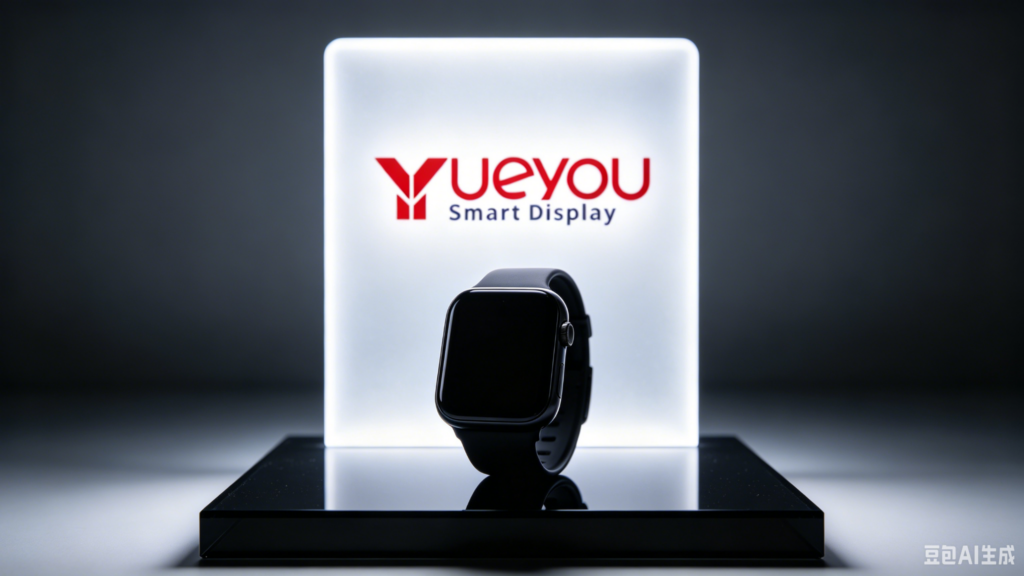
The branding method should be confirmed before the structure is finalized. If the logo is added too late, the panel may not have enough space or the lighting may not illuminate it evenly. Yueyou’s customization service can be used when the display requires specific logo treatment, color matching or a custom form.
Charging and Hands-On Demonstration
If the smartwatch needs to remain active throughout the event, the charging system should be treated as part of the display structure.
The charging connector, cable route and holder position must be designed together. The cable should not cross the main visual area or pull the watch away from its intended angle. The connector should also be accessible enough for maintenance but not so visible that it damages the appearance of the display.
For an interactive display, the security cable must allow natural movement. Visitors should be able to lift the watch, inspect the screen and return it to the holder without feeling that the product is tightly restricted.
| Requirement | What the buyer should confirm | Factory response |
|---|---|---|
| Charging | Whether the watch must remain powered during the event | Integrate the charger and cable path into the base |
| Interaction | Whether visitors can pick up or try on the watch | Design controlled movement and suitable cable length |
| Security | Whether the display is open-access or staff-assisted | Select the appropriate tether or fixing method |
| Maintenance | Whether the charger or LED module may need replacement | Reserve access points inside the structure |
| Product changeover | Whether several watch models will be used | Use adjustable or replaceable holder components |
A common factory error is to design the acrylic holder first and add the charger later. This can result in visible wires, connector stress or an uncomfortable product angle. The charging system should be tested with the real product before bulk production.
Factory Development Process
The development process usually begins with the launch objective. We first need to understand whether the display will be used for a keynote stage, media preview, retail partner event, exhibition booth or hands-on experience zone.
The buyer then provides the watch dimensions, product photographs, logo files, brand colors, display quantity and delivery schedule. If charging, anti-theft protection or interactive use is required, those details should be confirmed at the beginning.
The factory develops the base, product holder, LED position, logo area, cable route and assembly method as one structure. A drawing or 3D concept is normally reviewed before the first sample is produced.
The sample should be tested with the actual smartwatch, charger, LED module and logo artwork. This makes it possible to identify reflection, stability, charging and assembly problems before mass production.
After the sample is approved, the factory freezes the production specification. This normally includes the acrylic material, thickness, surface finish, LED configuration, power input, logo process, dimensions, packaging method and inspection requirements.
What Brand Buyers Should Prepare
A quotation becomes more accurate when the buyer provides product and campaign information instead of only sending the keyword “smartwatch display stand.”
- Smartwatch model and dimensions
- Product quantity per display
- Charging and interaction requirements
- Logo files and brand guideline
- Preferred acrylic color or finish
- LED lighting preference
- Event type, target quantity, delivery date and destination
If the final design is not ready, product photos, a rough sketch and a reference image are enough for the factory to begin discussing the structure.
When comparing suppliers, the brand should look beyond the unit price. Sample accuracy, LED consistency, packaging quality, replacement parts and the supplier’s ability to reproduce the same design across multiple batches are equally important.
Problems to Avoid
The most common issue is excessive brightness. A brighter display is not necessarily more premium if it creates glare on the screen or makes the product difficult to photograph.
Another problem is treating the stand as a generic holder. A standard holder may not match the watch’s charging point, strap shape or required viewing angle.
Branding is also often added too late. Logo position, panel thickness and lighting should be considered during the initial design stage.
Finally, the complete display should be tested before production. The test should include the actual watch, charger, LED system, security cable and logo artwork rather than the empty acrylic structure.
Final Recommendation
An LED acrylic smartwatch display stand for a brand launch should be developed as a complete presentation system. The acrylic structure, LED lighting, charging system, product holder, branding and packaging all affect the final launch experience.
The most reliable process is to begin with the product and event objective, then develop the display around actual visitor behavior. After that, the factory should produce a complete sample and test the visual effect, screen reflection, product interaction, stability and transportation requirements.
Yueyou Display can support smartwatch brands with concept development, acrylic fabrication, LED integration, logo finishing, sampling, packaging and bulk production. Brands preparing a new product launch can review the custom smartwatch display solution or send the project requirements through the contact page.
FAQ
Can an acrylic smartwatch display stand include LED lighting?
Yes. LED modules can be integrated into the base, rear panel, edge-lit acrylic or logo area. The final lighting method depends on the desired visual effect, power input and event environment.
Can the stand charge the smartwatch during the event?
Yes. The charger can be integrated into the display, but the holder and cable route should be designed together to avoid connector stress and visible wiring.
Is clear acrylic suitable for premium smartwatch launches?
Clear acrylic is often suitable when the brand wants a lightweight, transparent and modern appearance. For stronger contrast or a more technical visual identity, clear acrylic can be combined with black, frosted or colored acrylic.
Can the display stand be customized for different smartwatch models?
Yes. The holder, spacing, base, logo area and charging position can be customized according to the product model and display quantity.
What is the correct acrylic thickness?
There is no universal thickness. The factory should select it according to the display size, load, support structure, appearance and transport conditions, then verify it through sampling.