Walk into an optical store and look at the display before you look at the glasses.
Sounds strange, right?
Yet the display quietly shapes how every pair of frames is perceived.
A bulky fixture can make a delicate frame feel heavier. A dark background can compete with translucent acetate. Too many visible supports can turn a clean eyewear collection into visual clutter. And when several frame colors sit together, a strong display material may become part of the color story whether you intended it or not.
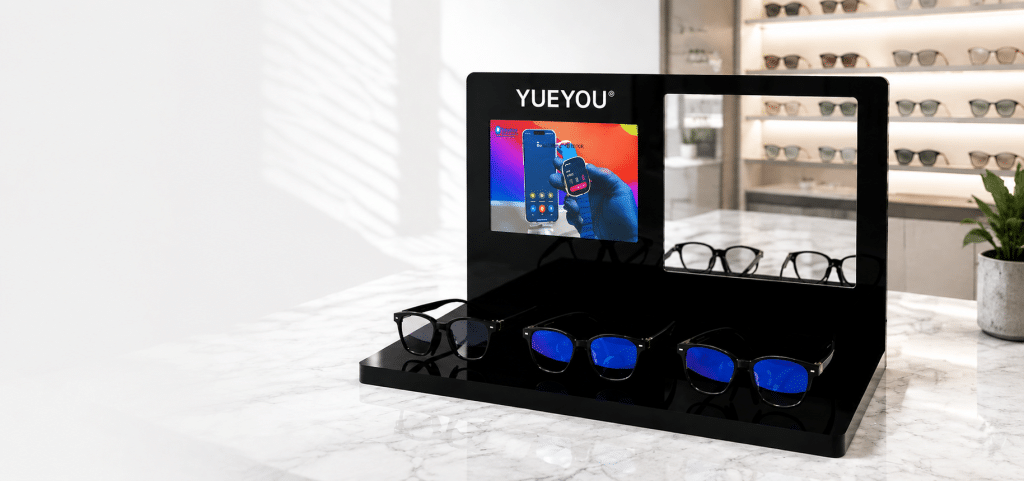
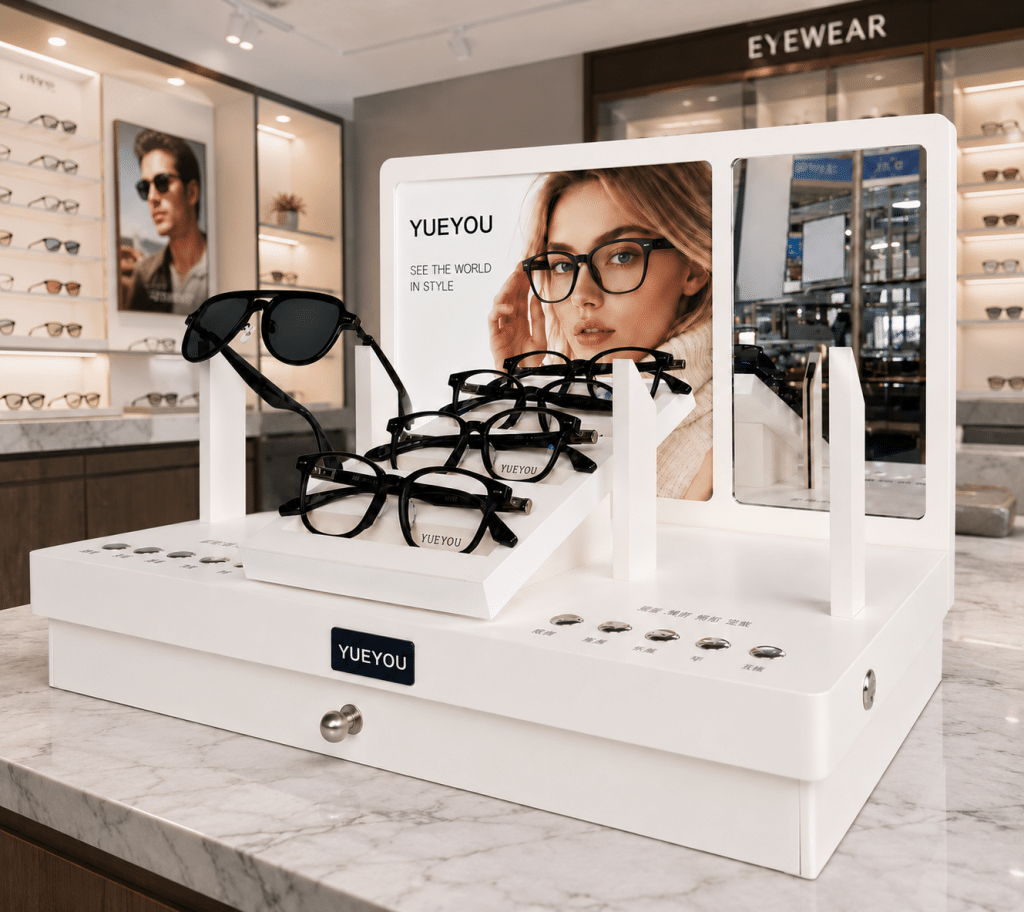
That is one reason transparent acrylic eyewear displays are so common in optical stores, sunglass boutiques, department stores, and branded retail counters.
Clear acrylic does not need to shout. Its strength is almost the opposite: it can step back visually and give the eyewear more room to speak.
Why Eyewear Displays Should Be Visually Quiet
Eyewear is unusually detail-sensitive.
Customers are not simply looking at “a pair of glasses.” They are noticing frame shape and proportion, acetate color and pattern, metal finishes, lens tint, bridge design, temple details, logo placement, and overall craftsmanship.
Some of those details are tiny.
Put them on an aggressive display fixture and the presentation becomes a competition between the frame and the stand.
Transparent acrylic solves part of this problem because the support structure carries less visual weight than many opaque materials.
The stand is still physically there. You can touch it. It holds the frame.
But visually? Much of the surrounding store remains visible through it.
That creates visual quietness.
And in eyewear merchandising, quietness can be surprisingly powerful.
The Real Benefit of Transparency: Less Competition
Imagine a transparent grey acetate frame.
Now place it on a thick black stand.
Your eye sees two objects immediately: the frame and the black structure underneath it.
Put the same frame on a well-designed clear acrylic holder and something changes. The support becomes less dominant, so the outline of the eyewear becomes easier to read.
That does not mean transparent acrylic is literally invisible.
It reflects light. Its edges are visible. Poor fabrication can make it very visible indeed.
But a properly finished clear acrylic display usually introduces fewer competing colors and surfaces into the presentation.
That is useful when you sell eyewear collections with very different visual personalities.
Black frames. Crystal frames. Tortoiseshell. Gold wire. Pastel acetate. Sport sunglasses. Gradient lenses.
One neutral transparent fixture can work with all of them.
Clear Acrylic vs. Glass for Eyewear Displays
This comparison comes up often because the two materials can create a similar transparent appearance.
Glass has its strengths. It feels solid and can work beautifully in permanent retail fixtures.
Acrylic offers a different set of advantages.
For fabricated countertop displays, acrylic is lighter and can be cut, bent, machined, bonded, printed, and formed into a wide range of shapes. That makes it particularly useful when an eyewear brand needs something beyond a simple flat shelf.
You might need:
- a three-tier sunglass riser
- individual frame holders
- a stepped countertop unit
- a logo header
- integrated mirrors
- removable graphics
- different frame positions
- a custom footprint for a specific retail counter
That is where fabrication flexibility becomes important.
There is another subtle visual difference. Depending on the glass type and thickness, glass edges can show a green tint. Clear acrylic can produce a more neutral-looking transparent edge, although the final appearance depends heavily on material quality and polishing.
That does not make acrylic universally better than glass.
Acrylic can scratch. Poor cleaning methods can damage its surface. Glass has different surface and weight characteristics.
The better question is not: “Which material is best?”
It is: “Which material suits this particular retail display?”
For custom countertop eyewear fixtures where low visual weight, lower physical weight, and fabrication flexibility matter, clear acrylic is often a strong candidate.
Acrylic vs. Wood: Product Neutrality or Material Character?
Wood does something transparent acrylic deliberately avoids.
It brings personality.
Walnut feels different from pale oak. A dark veneer can create warmth and luxury. Natural grain can support heritage, craft, or lifestyle branding.
That can be wonderful.
But it also means the display becomes part of the visual composition.
For an eyewear collection built around natural tones, that may be exactly what you want.
For a collection containing twenty frame colors?
Maybe not.
Clear acrylic provides a more neutral stage.
It lets a burgundy acetate frame stay burgundy. A translucent blue frame does not have to visually compete with a brown wood grain underneath it.
There is no universal winner here.
The brand determines the answer.
Acrylic vs. Metal: Presence Versus Transparency
Metal can be precise, strong, and visually distinctive. It is useful for structural elements and larger retail systems, and it works especially well when the brand wants an industrial or architectural feel.
Yet metal creates visible lines.
A black support stays visually black. Chrome reflects its surroundings. Brushed brass brings its own color into the scene.
Transparent acrylic behaves differently.
Its supporting components can appear lighter, particularly from normal customer viewing distances.
For thin metal frames, rimless glasses, or transparent acetate, that can help preserve the delicacy of the product.
Sometimes the smartest material decision is not “either/or.”
It is both.
How Acrylic Compares With Other Eyewear Display Materials
| Material | Visual Presence | Weight | Custom Fabrication | Good Fit For |
| Clear Acrylic | Low / transparent | Lightweight | High | Eyewear, sunglasses, premium retail displays |
| Glass | Clear / premium | Heavy | Low to Medium | Luxury displays, showcases, fixed installations |
| Wood | Warm / solid | Medium to Heavy | High | Boutique stores, lifestyle and natural-style displays |
| Metal | Sleek / industrial | Medium to Heavy | Medium to High | Modern stores, durable display structures |
| Mixed Materials | Flexible / layered | Varies | Very High | Custom branded displays and premium retail concepts |
Why Transparency Works So Well for Eyewear
Eyewear is a product people want to examine, not merely notice.
A customer may first see the silhouette of a frame, but a closer look reveals much more: the curve of the temples, the color of the acetate, the finish of the hinges, the shape of the bridge, and even subtle details around the lenses.
A display should help those details come forward.
This is where transparent acrylic earns its place.
Because clear acrylic allows much of the surrounding environment to remain visible, the fixture can feel less dominant than an opaque display of the same size. The customer’s attention has fewer visual obstacles between the eye and the eyewear.
Think of it like a picture frame.
A decorative frame can become part of the artwork. A simple frame, however, lets the artwork take the lead.
Eyewear displays work in a similar way.
For optical stores and sunglass retailers carrying many styles at once, this neutrality can be especially useful. A clear acrylic eyewear display can support black frames, transparent acetate, bright fashion colors, thin metal frames, and tinted sunglasses without introducing another strong color into the presentation.
That flexibility also matters when collections change.
Spring may bring lighter colors and translucent frames. Summer can shift attention toward sunglasses. Later collections may introduce darker acetate or metallic finishes.
The display does not necessarily need to change with every collection.
The eyewear changes.
The transparent stage stays quiet.
Material Quality Matters More Than “Clear”
Not every clear acrylic display looks the same.
This is an important point for buyers because “transparent” describes an appearance, not the complete quality of a finished display.
Material thickness, surface condition, cutting accuracy, edge finishing, bonding, bending, and overall fabrication all influence what the customer eventually sees.
A beautifully polished edge can make a display feel clean and refined.
A rough edge can do the opposite.
The same is true of joints. Excess adhesive, visible bubbles, uneven bonding, or poorly finished corners can attract attention for all the wrong reasons.
And that creates a small irony.
The whole reason for choosing a transparent display may be to reduce visual distraction, yet poor fabrication can make the display itself the distraction.
So when evaluating a custom acrylic eyewear display, do not judge the material only by asking whether it is clear.
Look at the finish.
Look at the edges.
Look at the joints.
Look at how consistently the parts fit together.
Those details often separate an ordinary clear plastic fixture from a polished retail presentation.
What Should You Look for in a Custom Acrylic Eyewear Display?
Choosing an acrylic eyewear display is not only about picking a shape you like.
For retailers, eyewear brands, distributors, and visual merchandising teams, the display also needs to work in a real retail environment.
Start with the eyewear itself.
How many pairs need to be displayed? Are they sunglasses, optical frames, or both? Will customers remove the frames frequently? Does the display sit on a counter, inside a showcase, or on a larger retail fixture?
These questions affect the structure of the display.
A good custom design should also consider the dimensions of the frames. Oversized sunglasses may require more spacing than narrow optical frames, while different bridge and temple designs can affect how securely each pair sits on its holder.
Then there is branding.
A transparent acrylic display does not have to be completely anonymous. Logos, printed graphics, colored acrylic accents, header panels, mirrors, and other elements can add brand identity without allowing the fixture to overpower the eyewear.
For buyers comparing custom acrylic eyewear display manufacturers, it helps to evaluate more than the initial appearance.
Pay attention to:
- acrylic thickness and material clarity
- edge polishing and surface finish
- stability of the base
- spacing between individual eyewear positions
- quality of bends and bonded joints
- logo and graphic application
- ease of cleaning
- packaging for transportation
- consistency across larger production quantities
A display may look simple from a distance, but these small details affect how it performs once it reaches the store.
For B2B buyers, consistency matters just as much as the first sample.
A prototype may look excellent. The real test is whether the same dimensions, finish, branding, and assembly quality can be maintained when the order moves into production.
That is why a clear specification before production is so useful.
Why a Prototype Matters Before Mass Production
A prototype is one of the most useful steps in a custom acrylic eyewear display project.
A rendering can show the overall shape, dimensions, and branding, but a physical sample reveals things a screen cannot.
Place the actual eyewear on the display.
Does each frame sit securely?
Is the spacing comfortable?
Can store staff remove and replace the eyewear easily?
Does the base feel stable on the counter?
These questions may sound small, but they become much more important when a display is used every day.
A prototype also gives buyers a chance to inspect the acrylic itself. Check the clarity, edge finish, bends, bonded joints, logo position, and overall proportions.
Then step back and look at the display from a shopper’s point of view.
Does the fixture support the eyewear, or does it attract too much attention?
That is the real test.
Once the prototype has been reviewed and approved, the specifications can be confirmed before larger production begins.
A few adjustments at the sample stage are usually much easier than trying to correct the same issue across an entire production run.
Acrylic Thickness Is a Design Decision, Not Just a Number
Buyers often ask one practical question early in a project:
“What acrylic thickness should we use?”
There is no single answer that works for every eyewear display.
Thickness depends on the size of the fixture, the number of frames it holds, the distance between supports, the shape of the base, the fabrication method, and the overall design.
A thin acrylic component can create a light, minimal appearance.
A thicker piece can feel more substantial and architectural.
But appearance is only part of the decision.
The material also needs enough stiffness for the structure it is supporting.
That is why acrylic thickness should be selected according to the actual display design rather than copied from another product.
For custom transparent acrylic eyewear displays, the safest approach is to review the structure and confirm the final thickness during sampling.
Cleaning and Maintenance of Transparent Acrylic Eyewear Displays
Transparent acrylic eyewear displays look best when their surfaces are clean and free from dust, fingerprints, and scratches.
For everyday maintenance, use a soft microfiber cloth and a mild cleaning solution suitable for acrylic surfaces.
Avoid abrasive pads or rough cloths that may leave fine scratches.
Strong solvents should also be avoided unless they have been confirmed as compatible with the specific acrylic material.
Cleaning technique matters too.
Rather than aggressively rubbing a dusty surface, remove loose particles gently before wiping the display.
This is especially important for transparent acrylic eyewear displays because strong store lighting can make small surface marks more noticeable.
For retailers, maintenance should also influence the original display design.
Can staff easily reach the surfaces that need cleaning?
Can removable components be taken apart without tools?
Are there narrow corners where dust will collect?
A display that looks beautiful in a rendering but is difficult to maintain may become frustrating after several months of daily use.
Good display design considers the entire retail lifecycle, not only the first day in the store.
From Idea to Production: A Typical Custom Eyewear Display Process
A custom eyewear display usually begins with a simple question:
What should the customer notice first?
Sometimes the answer is the eyewear itself. Sometimes it is a new collection, a brand logo, a seasonal campaign, or a particular product feature.
Once that goal is clear, the display can begin to take shape.
A typical project may include the following stages:
- Design brief and requirements
- Concept and structural design
- Material and thickness selection
- Prototype and sampling
- Fit, stability, and visual review
- Branding and graphic confirmation
- Production
- Quality inspection and packaging
Each stage affects the next.
A beautiful concept still needs to be manufacturable. A stable structure still needs to present the eyewear attractively. Branding needs to be integrated without making the fixture visually heavy.
Sampling connects these decisions before full production begins.
For buyers, providing clear information early can make the process much smoother. Useful details include the eyewear dimensions, number of frames to display, preferred footprint, branding files, target quantity, store environment, and expected launch date.
The more clearly these requirements are defined, the easier it becomes to develop a display that fits the actual retail situation.
How Clear Acrylic Supports Different Eyewear Styles
Clear acrylic works well with many eyewear styles because it does not compete strongly with the product itself.
For bold sunglasses, a transparent display can keep the presentation from feeling too heavy.
For lightweight optical frames, clear supports can preserve a clean and delicate appearance.
For colorful eyewear, the neutral transparency allows the frame colors to remain the visual focus.
This flexibility is especially useful for retailers that regularly change collections or display different product styles on the same fixture.
The display can stay visually consistent even when the eyewear changes.
In this way, clear acrylic becomes less of a decorative element and more of a flexible visual platform for the merchandise.
Where Transparent Acrylic Eyewear Displays Work Best
Transparent acrylic eyewear displays are especially effective in retail environments where the product itself needs to remain the visual priority.
Optical stores can use clear acrylic holders to organize different frame styles without adding another strong color or texture to the display area.
Sunglass counters can use transparent risers to create height and separation while keeping the presentation open.
They also work well for product launches, temporary retail campaigns, trade show displays, showroom presentations, and branded countertop fixtures.
For multi-brand retailers, clear acrylic can be particularly useful because one neutral display style can support many different eyewear collections.
The same fixture may present minimalist metal frames one month and bold acetate sunglasses the next.
That adaptability can reduce the need to redesign every display whenever the product mix changes.
Clear acrylic is not the right answer for every retail concept. Some brands may prefer wood, metal, or strongly colored materials because those finishes are part of their visual identity.
But when the goal is to keep attention on the eyewear while maintaining a clean, modern presentation, transparent acrylic is difficult to ignore.
Final Thoughts: Let the Eyewear Lead
A transparent acrylic eyewear display works best when it knows when to step back.
Its job is not to steal attention from the product. Its job is to support the frame, organize the presentation, and create enough visual space for the eyewear to stand out.
That is why material clarity, edge finishing, thickness, structure, spacing, and fabrication quality all matter.
Acrylic alone does not make a display premium.
Good design does.
Good workmanship does.
And most importantly, the display needs to suit the actual eyewear and the retail environment where it will be used.
For eyewear brands, optical retailers, and distributors developing a custom display, the strongest results usually come from starting with the product first and building the fixture around it.
When that happens, the display becomes quieter.
The eyewear becomes clearer.
And the customer sees what really matters.
Planning a Custom Acrylic Eyewear Display?
If you are developing a custom acrylic eyewear display for an optical store, sunglass collection, product launch, or retail campaign, prepare the basic project information before requesting a quotation.
Useful details include eyewear dimensions, display quantity, target order quantity, reference images, branding files, preferred materials, and expected delivery schedule.
A clear brief helps your display manufacturer evaluate the structure, material thickness, branding method, packaging, and prototype requirements more accurately.
Ready to discuss your eyewear display project? Contact our team with your product details and project requirements.
Frequently Asked Questions
Why are transparent acrylic eyewear displays popular in optical stores?
Transparent acrylic eyewear displays reduce visual clutter and allow the frames to remain the main focus. They also work well with many frame colors and retail styles because the material adds very little competing color or texture.
Is clear acrylic better than glass for eyewear displays?
It depends on the project. Clear acrylic is lighter and easier to fabricate into custom shapes, while glass offers a different feel and surface character. For custom countertop displays, acrylic often provides greater design flexibility.
What acrylic thickness should be used for an eyewear display?
There is no single thickness that works for every display. The correct thickness depends on the size, structure, span, number of frames, fabrication method, and stability requirements. A prototype is useful before mass production.
Can transparent acrylic eyewear displays be customized with logos?
Yes. Logos can be added through printing, engraving, branded panels, colored accents, or other decorative elements. The branding should remain balanced so the eyewear stays visually dominant.
What information should I provide for a custom acrylic eyewear display quote?
Provide the eyewear dimensions, display size, target order quantity, reference images, branding files, preferred materials, packaging requirements, and expected delivery schedule. Clear project information helps the manufacturer prepare a more accurate quotation and prototype plan.
★ Ready to create a display that puts your eyewear in the spotlight? Contact our team today for a free consultation and quote